
AI in Bookkeeping: How AI in Accounting Saves Time, Cost & Boosts Efficiency
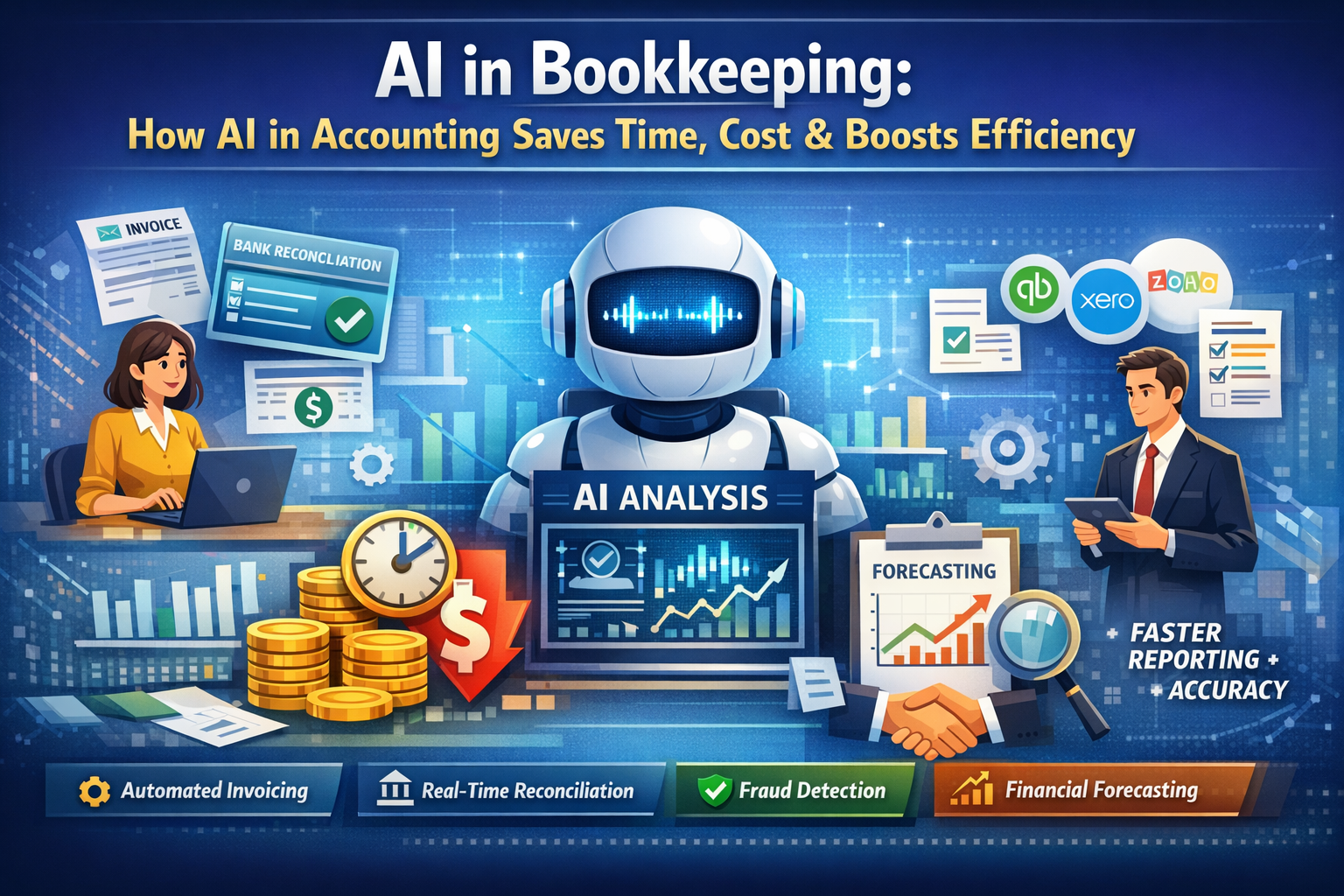
AI in Bookkeeping: The Smartest Upgrade Your Accounting Needs Today | Unified Books
If you still think bookkeeping is about spreadsheets, manual entries, and endless reconciliations—you’re already behind. AI in bookkeeping is not just evolving the accounting industry, it’s redefining it completely.
Today, businesses and CPA firms using AI in accounting are closing books faster, reducing errors significantly, and saving substantial costs—while others are still stuck in outdated processes. At Unified Books, we believe the future belongs to firms that embrace accounting and artificial intelligence together. This combination is helping businesses move from reactive accounting to proactive financial decision-making. Whether you’re a CPA firm, startup, or scaling business, adopting AI for accounting is no longer optional—it’s essential for growth and competitiveness.
What is Artificial Intelligence in Accounting?
To truly understand the impact, let’s first clarify what is artificial intelligence in accounting. AI in accounting refers to the use of machine learning, automation, and intelligent algorithms to perform tasks such as bookkeeping, reconciliations, data entry, financial analysis, and reporting. In simple terms, AI in bookkeeping means systems that can learn from past data, identify patterns, and execute tasks faster and more accurately than humans. Instead of spending hours on repetitive work, accountants can focus on high-value tasks like advisory, planning, and client relationships. This is why AI for accounting is becoming a core part of modern financial systems.
AI in Accounting: From Manual Work to Intelligent Automation
The shift towards AI in accounting is massive. Traditionally, accounting involved manual data entry, invoice processing, and time-consuming reconciliations. Today, with advanced AI tools for accountants, these tasks are automated with high accuracy and speed. Using platforms like QuickBooks Online, Xero, Zoho Books, Vic.ai, Bill.com, ChatGPT, Claude and Botkeeper, firms can automate transaction categorization, invoice processing, anomaly detection, and reporting. These AI tools for accountants not only improve efficiency but also enable scalability without increasing team size.
Managing bookkeeping manually can slow down your business growth and increase the chances of errors. Many growing firms now prefer to outsource your bookkeeping to expert teams who use AI-driven systems for faster and more accurate results. This not only reduces workload but also ensures your financial data is always up to date.
Here, “outsource your bookkeeping"
How to Use AI in Accounting (Practical Approach)
Many firms understand the concept of AI in accounting, but the real challenge lies in implementation. The best way to adopt AI in bookkeeping is to start small and gradually integrate AI into your daily workflows.
1. Automate Data Entry & Invoice Processing
Manual data entry is one of the biggest time-consuming tasks. Tools like QuickBooks Online and Xero can automatically fetch bank feeds and scan invoices. Additionally, AI tools like ChatGPT and Claude can extract data from PDFs, convert it into structured formats, and clean financial data. For example, you can upload 100 invoices and AI will extract vendor names, dates, and amounts within minutes—something that would take hours manually. This is one of the most practical uses of AI tools for accountants.
2. Smart Transaction Categorization
AI learns patterns from historical data and automatically categorizes transactions. Instead of manually assigning ledgers, AI tools categorize expenses like rent, utilities, or office supplies accurately. You can also use ChatGPT to review bank data and suggest categorization rules, improving consistency in AI in bookkeeping and strengthening AI for accounting workflows.
3. Real-Time Bank Reconciliation
Reconciliation is traditionally time-consuming. With AI in accounting, transactions are automatically matched with records. AI tools for accountants identify missing entries, duplicates, and mismatches instantly. What used to take hours can now be completed in minutes, making processes faster and more reliable.
4. Accounts Payable & Receivable Automation
AI can automate invoicing, payment reminders, receivable tracking, and even predict payment delays. This improves cash flow management and reduces manual follow-ups. Businesses using AI for accounting can maintain better financial control with minimal effort. For example, if a company raises 100 invoices in a month, AI tools like QuickBooks Online, Xero, and Zoho Books can automatically generate invoices, send scheduled reminders, and track outstanding payments. These AI tools for accountants can also analyze past payment patterns to predict which clients are likely to delay payments, allowing businesses to take proactive action, improve collections, and maintain a steady cash flow without constant manual follow-up.
5. Financial Analysis & Forecasting
This is where AI in accounting becomes truly powerful. Tools like ChatGPT and Claude can analyze financial data, identify trends, detect cost leakages, and forecast future performance. For example, uploading a P&L statement and asking AI for profitability insights can deliver actionable suggestions instantly. This makes AI tools for accountants essential for strategic decision-making.
6. Backlog & Cleanup Accounting
For businesses with incomplete records, AI in bookkeeping is extremely effective. AI tools for accountants can process months or even years of data, categorize transactions, and reconcile accounts quickly. This makes AI for accounting highly valuable for cleanup and compliance projects.
7. Continuous Monitoring & Reporting
Once implemented, AI works continuously in the background. It generates reports, tracks KPIs, flags anomalies, and provides alerts. This is the real strength of accounting and artificial intelligence—it not only processes data but actively monitors financial performance.
Benefits of AI Bookkeeping (Detailed Breakdown)
The benefits of AI bookkeeping go far beyond automation. They directly impact efficiency, profitability, and decision-making.
1. Massive Time Savings
AI reduces manual work by 60–70%. Tasks that take hours can be completed in minutes using AI in accounting.
2. Significant Cost Reduction
With AI for accounting, businesses can reduce accounting costs by 30%–50% by minimizing manual effort.
3. Improved Accuracy & Error Reduction
AI systems reduce errors by up to 90%, making this one of the biggest benefits of AI bookkeeping.
4. Real-Time Financial Insights
AI provides live dashboards and reports, enabling faster decisions through accounting and artificial intelligence.
5. Faster Backlog & Cleanup Accounting
One of the major benefits of AI bookkeeping is handling bulk data quickly, reducing weeks of work into days.
6. Scalability Without Hiring
With AI in bookkeeping, firms can manage more clients without increasing headcount.
7. Better Fraud Detection & Risk Management
AI tools for accountants identify unusual transactions and flag risks instantly.
8. Consistency Across Processes
AI ensures standardized accounting practices across all financial records.
9. Improved Client Experience
Faster turnaround and accurate reporting enhance client satisfaction using AI in accounting.
10. Forecasting & Strategic Planning
One of the most valuable benefits of AI bookkeeping is forecasting. AI can predict cash flow, future expenses, and revenue trends. This transforms AI for accounting from an operational tool into a strategic advantage.
AI in Regular Accounting vs Backlog/Cleanup Accounting
In regular workflows, AI in bookkeeping ensures daily transactions are recorded, categorized, and reconciled automatically. This keeps books updated in real time. In backlog accounting, AI in accounting becomes even more powerful. AI tools for accountants can process large volumes of historical data quickly, making AI for accounting highly efficient for cleanup and compliance work.
One of the biggest advantages of AI is its ability to handle bulk data efficiently. Businesses struggling with incomplete records can benefit from backlog accounting & cleanup services, where AI tools quickly organize and reconcile months of financial data within days.
Practical Case Study: AI vs Traditional Bookkeeping
Client Type: US-based eCommerce Business
Monthly Transactions: 3,500+
Traditional Approach: 120–140 hours/month, 2–3 accountants, moderate error rate, 10–12 days closing.
AI-Based Approach (using AI tools for accountants like QuickBooks Online + Vic.ai): 35–45 hours/month, 1 accountant + AI, very low errors, 3–4 days closing.
Result: 70% time saved, 60% cost reduced, faster reporting and better decisions. This clearly shows how AI in bookkeeping and AI for accounting transform efficiency.
How Much Time and Money Can Be Saved?
Businesses using AI in accounting typically save 40%–70% time, 30%–50% cost, and achieve up to 80% faster cleanup. This makes AI for accounting one of the most cost-effective investments for modern businesses.
Why AI in Bookkeeping is the Future
The future of AI in bookkeeping lies in smarter systems that go beyond automation. From tax planning to predictive analytics, AI tools for accountants will continue to evolve. Businesses adopting AI for accounting early will gain a long-term competitive advantage.
With the rise of AI in bookkeeping, businesses across the USA and UK are increasingly adopting offshore accounting services to reduce costs while maintaining high-quality output. Combining AI tools with offshore expertise creates a powerful and scalable accounting solution.
FAQs on AI in Bookkeeping
1. What is AI in bookkeeping?
AI in bookkeeping refers to using automation and machine learning to handle accounting tasks like data entry, reconciliation, and reporting.
2. How does AI in accounting improve accuracy?
AI reduces human errors by automating repetitive tasks and learning from historical data patterns.
3. Which are the best AI tools for accountants?
Popular tools include QuickBooks Online, Xero, Vic.ai, and Botkeeper.
4. How to use AI in accounting for small businesses?
Start with automating invoicing, bank reconciliation, and expense tracking using AI-powered accounting software.
5. Can AI replace accountants?
No, AI supports accountants by automating tasks, allowing them to focus on advisory and strategic roles.
6. What are the benefits of AI bookkeeping?
Time savings, cost reduction, improved accuracy, real-time insights, and scalability are key benefits.
7. Is AI useful for backlog accounting?
Yes, AI can process large volumes of historical data quickly, making cleanup accounting faster and more efficient.
8. How much cost can AI save in accounting?
Businesses can save up to 30%–50% in accounting costs using AI.
9. Is AI accounting secure?
Yes, most AI accounting tools use advanced encryption and security protocols to protect financial data.
10. Why choose Unified Books for AI accounting services?
Unified Books combines AI technology with expert accountants to deliver accurate, efficient, and scalable accounting solutions globally.
Conclusion: AI in Bookkeeping is No Longer Optional
The transformation driven by AI in bookkeeping is real, measurable, and already reshaping the accounting industry. Businesses that are leveraging AI in accounting are not only saving time and reducing costs but also gaining a competitive advantage through faster insights and better financial control.
From automating daily bookkeeping tasks to handling complex backlog and cleanup accounting, AI tools for accountants are proving their value at every level. The combination of accounting and artificial intelligence enables firms to scale operations, improve accuracy, and deliver higher value to clients.
If you are still relying on traditional methods, you are not just missing efficiency—you are missing growth opportunities. Adopting AI for accounting today means building a future-ready accounting system that works faster, smarter, and more profitably. we help you unlock the full potential of AI in accounting with the right tools, processes, and expert support to to maximize efficiency and profitability and so you don’t just keep up with the future, you lead it. The future belongs to those who adapt—and with AI, that future starts now.
Written by