
How Remote Bookkeeping Works for US Companies (Complete Guide with Real Examples & Case Study)
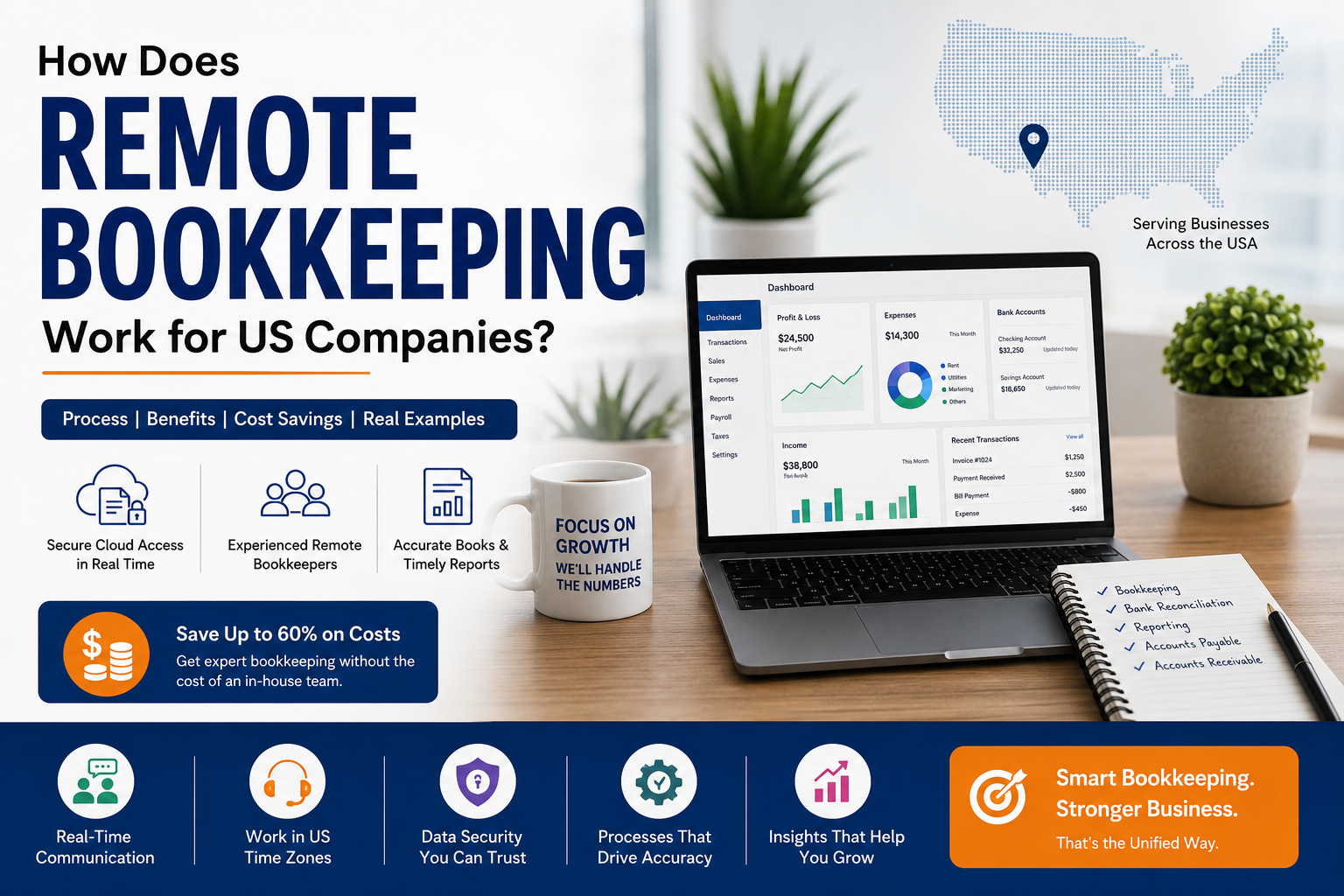
How Does Remote Bookkeeping Work for US Companies? (Complete Guide with Real Examples & Case Study)
In today’s fast-moving business environment, US companies are increasingly shifting toward remote bookkeeping to reduce costs, improve efficiency, and access global expertise. But how exactly does remote bookkeeping work in practice? Is it reliable? And how does it compare with hiring an in-house bookkeeper?
US companies are increasingly moving toward outsourced bookkeeping USA and outsourced accounting USA models to stay competitive while maintaining financial accuracy.
Let’s break it down in a practical, real-world way—so you can clearly understand how this model fits into your business.
What is Remote Bookkeeping?
Remote bookkeeping means managing a company’s financial records from a different location—often offshore—using cloud-based accounting tools like QuickBooks, Xero, Sage, Odoo or Zoho Books.
Instead of sitting in your office, a remote bookkeeper works virtually, accessing your financial data securely and updating books in real time.
The key difference is not what they do—but how and where they do it. This is why many businesses now prefer outsourced bookkeeping USA solutions instead of relying solely on in-house resources.
How Remote Bookkeeping Works (Step-by-Step Process)
1. Setup & Access
The business provides secure access to accounting software, bank feeds, and relevant documents.
2. Daily Transaction Recording
The remote bookkeeper records income, expenses, invoices, and payments—just like an in-house resource.
3. Bank & Credit Card Reconciliation
Accounts are reconciled regularly to ensure accuracy and avoid discrepancies.
4. Real-Time Communication
They make themselves available as and when required and share queries on a real-time basis—via Slack, Teams, or email.
5. Query Resolution at Their End
A professional remote bookkeeping team follows a structured approach. Instead of escalating every small issue to a CPA, they resolve most queries internally—this is a key advantage of outsourced accounting USA services.
6. Reporting & Insights
Monthly reports such as Profit & Loss, Balance Sheet, and Cash Flow are prepared and shared.
7. Time Zone Alignment
Remote bookkeepers typically work as per US time zones or maintain a partial overlap, ensuring smooth communication and timely delivery.
Real-Life Example (How It Actually Works)
A small e-commerce business in Texas hires a remote bookkeeping team.
- Sales data auto-syncs daily into QuickBooks
- The bookkeeper categorizes transactions within 24 hours
- Weekly reconciliations ensure accuracy
- Queries are discussed over Slack with a 2–3 hour overlap
- Monthly financials are delivered by the 3rd working day
The owner focuses on scaling, while the backend is handled seamlessly.
Case Study – US Marketing Agency Saving 60% Cost
Client: Digital Marketing Agency (California)
Challenge: High payroll cost + inconsistent bookkeeping
Solution: Shifted to a remote bookkeeping team
Before
- 1 in-house bookkeeper
- Cost: $5,000/month
- Delays in reporting
- Frequent CPA dependency
After Remote Setup
- Dedicated remote team
- Cost: $2,000/month
- Weekly reporting
- 80% queries resolved internally
Result
- 60% cost reduction
- Faster reporting cycles
- Better financial visibility
- Reduced CPA billing
This transition to outsourced bookkeeping USA not only reduced costs but also improved operational efficiency.
On-Roll Bookkeeper vs Remote Bookkeeper (Clear Comparison)
Factor
On-Roll Bookkeeper
Remote Bookkeeper
Cost
High (salary + benefits)
50–70% lower
Availability
Fixed hours
Flexible + time zone overlap
Expertise
Limited to one person
Team-based expertise
Scalability
Difficult
Easily scalable
Technology
May be limited
Cloud-first approach
Query Resolution
CPA dependent
Mostly resolved internally
Backup
No backup
Dedicated team support
Speed
Moderate
Faster turnaround
Reporting
Monthly
Weekly / real-time
Efficiency
Moderate
High
10 Advantages of Having a Remote Bookkeeper
- Significant Cost Savings (up to 60–70%) through outsourced bookkeeping USA
- Access to Skilled Professionals without hiring locally
- Faster Turnaround Time
- Time Zone Advantage (overnight work completion)
- Scalable Support as business grows
- Better Process Discipline with SOP-driven work
- Reduced CPA Dependency
- Use of Latest Cloud Tools
- Dedicated Team Instead of One Person
- Business Focus Improves as admin burden reduces
How Remote Bookkeeping is Cost-Effective
Remote bookkeeping reduces multiple hidden costs:
- No employee benefits (insurance, bonuses, payroll taxes)
- No office space or infrastructure
- No training costs
- Reduced CPA billing due to fewer escalations
For example, a US company paying $4,000/month locally can often get the same or better service remotely for $1,500–$2,000/month.
This is one of the biggest reasons why outsourced accounting USA is becoming the preferred model for growing businesses. That’s not just savings—it’s better ROI.
Is Remote Bookkeeping Really Reliable?
This is where most businesses hesitate.
But in reality, a good remote bookkeeping team:
- Communicates proactively
- Makes themselves available whenever required
- Shares queries instantly and resolves them quickly
- Builds long-term relationships, just like an internal team
It’s not just outsourcing—it’s an extension of your business.
10 Practical FAQs About Remote Bookkeeping
1. Is remote bookkeeping secure?
Yes, with encrypted cloud software and controlled access, it’s highly secure.
2. Will communication be a problem?
No, most teams work in US time zones or maintain overlap hours.
3. What tools are used?
QuickBooks, Xero, Zoho Books, Hubdoc, Bill.com, etc.
4. Can they handle complex accounting?
Yes, experienced teams handle multi-entity and industry-specific accounting.
5. What about tax compliance?
They prepare books; CPAs handle filing—but many queries are resolved internally.
6. How quickly can I get reports?
Weekly or even real-time dashboards are possible.
7. What if my business grows?
Remote teams scale easily without hiring delays.
8. Will I lose control over finances?
No, you actually gain better visibility through structured reporting.
9. How are queries handled?
Shared in real-time and resolved promptly.
10. What if someone is unavailable?
Unlike in-house staff, remote teams provide backup support.
Conclusion
Remote bookkeeping is no longer just a cost-saving option—it’s a smarter way of managing finances. With structured processes, real-time communication, and global expertise, US companies can achieve better accuracy, faster reporting, and significant savings.
As more businesses shift toward outsourced bookkeeping USA and outsourced accounting USA, the future clearly belongs to flexible, global financial operations. The real advantage lies in having a professional team that doesn’t just record numbers—but understands your business, resolves issues proactively, and works alongside you as a financial partner.
Written by