
Lease Accounting as per US GAAP ASC 842-Examples, Case Study

Lease Accounting as per US GAAP (ASC 842): Complete Practical Guide with Examples, Journal Entries & Disclosures
Lease accounting has become one of the most critical and judgment-heavy areas of financial reporting for US businesses. With the implementation of ASC 842 lease accounting under US GAAP, leases are no longer treated as simple rent expenses. They directly affect balance sheets, leverage ratios, EBITDA, lender covenants, and CPA audit outcomes. Many US businesses still face challenges in identifying leases correctly, classifying them properly, and maintaining accurate lease schedules on an ongoing basis. As a result, lease accounting remains one of the most common sources of CPA review adjustments and audit findings.
This is where expert US GAAP bookkeeping becomes essential. Unified Books is a specialized bookkeeping service provider focused exclusively on maintaining books in accordance with US GAAP. We help US businesses implement US GAAP ASC 842 correctly, maintain accurate lease schedules, record monthly journal entries, and prepare CPA-ready financial statements that withstand audit scrutiny. By combining technical accounting expertise with disciplined bookkeeping processes, We support startups, SMBs, and growing US companies across industries.
What Is Lease Accounting under US GAAP (ASC 842)
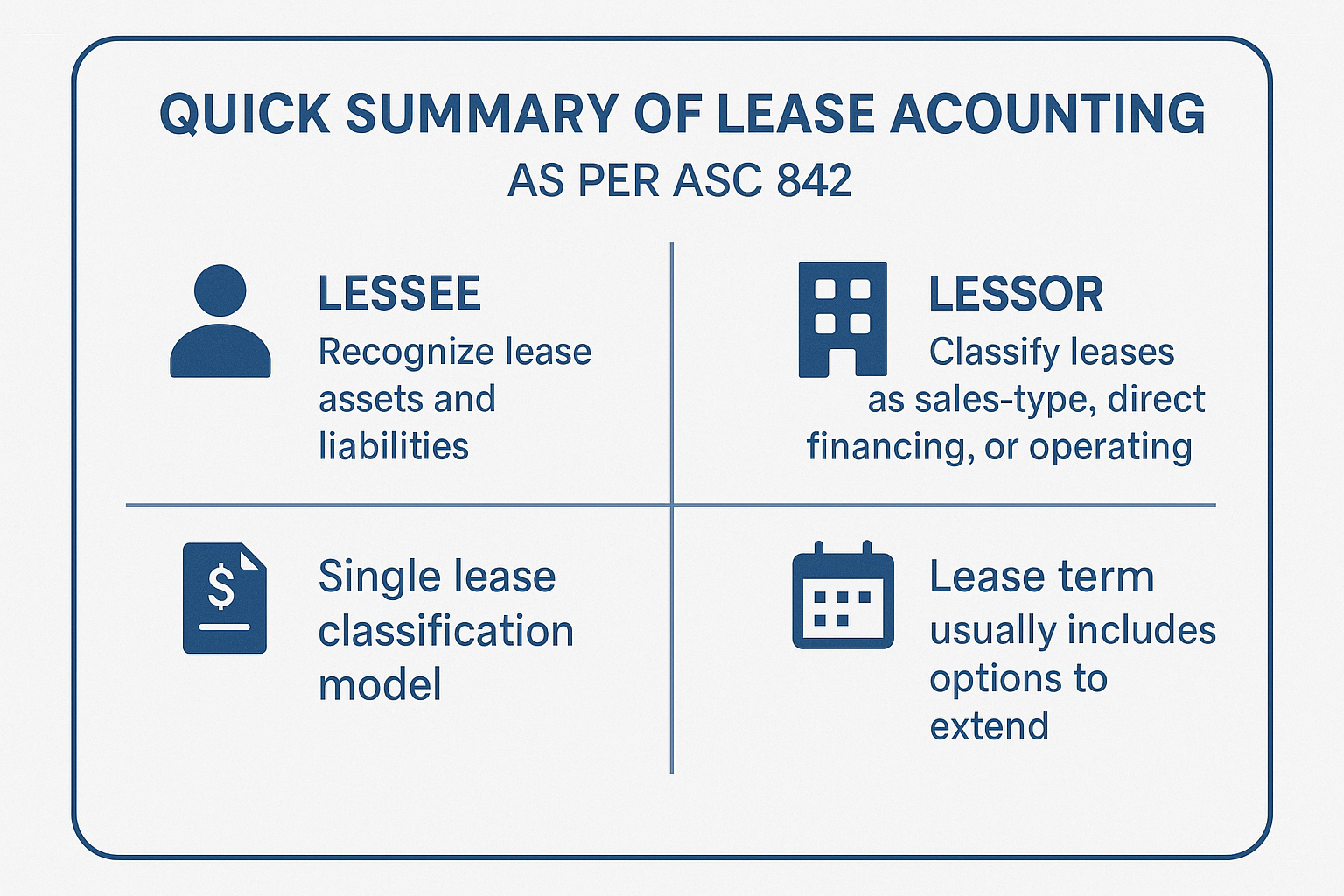
What is ASC 842 lease accounting? ASC 842 is the US GAAP standard governing lease accounting for both lessees and lessors. The core objective of ASC 842 is to improve transparency by requiring most leases to be recognized on the balance sheet. Under this standard, lessees must record a right-of-use (ROU) asset and a corresponding lease liability for nearly all leases, eliminating the off-balance-sheet treatment that existed under ASC 840.
Yes—both operating leases and finance leases are fully covered under ASC 842.
Under ASC 842, all leases (with limited exceptions such as short-term leases) fall within the scope of the standard. This includes both operating leases and finance leases for lessees as well as operating, sales-type, and direct financing leases for lessors.
For lessees, the key change introduced by lease accounting under ASC 842 is that both operating leases and finance leases are recognized on the balance sheet. In both cases, the lessee records a right-of-use (ROU) asset and a lease liability at the commencement date. The difference between operating and finance leases under ASC 842 relates primarily to income statement presentation and expense recognition, not balance sheet recognition. Operating leases result in a single straight-line lease expense, while finance leases result in separate recognition of interest expense and amortization of the ROU asset.
For lessors, ASC 842 continues to distinguish between lease types, but classification is based on whether control of the underlying asset transfers to the lessee. Lessors classify leases as operating leases, sales-type leases, or direct financing leases. The classification determines whether the lessor continues to recognize the underlying asset or records a net investment in the lease, as well as the timing and pattern of income recognition.
Why Lease Accounting Matters for US Businesses
Lease accounting affects reported assets, liabilities, and profitability metrics. Incorrect lease treatment can lead to misstated financial statements, failed lender covenant tests, delayed audits, and repeated CPA adjustments. Service contracts often contain embedded leases that are overlooked. Businesses that rely on generic bookkeeping or cash-basis records are especially exposed to ASC 842 non-compliance. Accurate lease accounting is now a compliance necessity, not an optional accounting refinement.
Scope of ASC 842
ASC 842 applies to leases of property, plant, and equipment. It excludes leases of intangible assets, inventory, biological assets, and assets under construction. The standard applies to both public and private companies and covers operating leases, finance leases, sales-type leases, and direct financing leases.
Lease Classification under ASC 842 (Lessee)
A lease is classified as a finance lease if it meets any one of the following criteria: ownership transfers to the lessee by the end of the lease term, the lease contains a purchase option reasonably certain to be exercised, the lease term covers a major portion of the asset’s remaining economic life, the present value of lease payments equals or exceeds substantially all of the asset’s fair value, or the asset is so specialized that it has no alternative use to the lessor. If none of these conditions are met, the lease is classified as an operating lease.
Initial Measurement – Lessee Accounting
At lease commencement, the lessee recognizes a lease liability measured at the present value of future lease payments discounted using the interest rate implicit in the lease or the lessee’s incremental borrowing rate. A right-of-use asset is recognized simultaneously and equals the lease liability adjusted for initial direct costs, prepaid lease payments, and lease incentives received. Initial measurement for operating and finance leases is the same.
Practical Example – Operating Lease Initial Recognition under ASC 842
Assume: • Lease term: 5 years • Annual payment: USD 50,000 (year-end) • Discount rate: 8% • Present value of lease payments: USD 199,500 • No initial direct costs or incentives
ASC 842 Journal Entries at Commencement
Right-of-Use Asset Dr 199,500 Lease Liability Cr 199,500
This entry is the same whether the lease is operating or finance.
Unified Books prepares and maintains such lease calculations with complete supporting schedules, ensuring alignment with CPA audit expectations.
Example 1 – Operating Lease Accounting (Lessee)
For an operating lease, a single lease expense is recognized on a straight-line basis in the income statement. Internally, interest on the lease liability and amortization of the ROU asset are calculated each period.
Year-one interest expense at 8 percent equals USD 15,960. Annual lease expense is USD 50,000. ROU asset amortization equals USD 34,040.
Step 1: Straight-Line Lease Expense Adjustment
Total lease expense required = 50,000Interest = 15,960ROU amortization (plug) = 34,040
Journal Entry:Lease Expense Dr 50,000Right-of-Use Asset Cr 34,040Interest Expense Cr 15,960
Step 2: Lease Payment & Interest Accrual (Lease liability unwinding)
Interest = 15,960Total payment = 50,000Principal reduction = 34,040
Journal Entry: Interest Expense Dr 15,960 Lease Liability Dr 34,040 Cash Cr 50,000
Example 2 – Finance Lease Accounting (Lessee)
If the lease qualifies as a finance lease, interest expense and amortization expense are presented separately. The ROU asset is amortized over the lease term.
Journal Entries – Year 1
Interest Expense Dr 15,960Lease Liability Dr 34,040Cash Cr 50,000ROU Asset Amortization Dr 39,900Accumulated Amortization – ROU Cr 39,900
Example 3 – Short-Term Lease Exemption
Leases with a term of twelve months or less may qualify for the short-term lease exemption. When elected, no ROU asset or lease liability is recorded, and lease payments are expensed as incurred.
Example 4 – Initial Direct Costs
Initial direct costs such as legal fees are added to the ROU asset and amortized over the lease term but do not increase the lease liability.
Example 5 – Lease Incentives
Lease incentives received from the lessor reduce the ROU asset and are recognized over the lease term, reducing periodic lease expense.
ASC 842 Implementation Challenges Faced by US Businesses
Many US businesses struggle with identifying embedded leases within service agreements, determining appropriate discount rates, collecting complete lease data across locations, and handling leases that lack formal documentation. Inconsistent application of renewal options and failure to reassess lease terms are also common issues. These challenges often surface during CPA reviews, resulting in rework and delays. Unified Books addresses these challenges by performing structured lease reviews, standardizing assumptions, and maintaining centralized lease registers.
Common Lease Accounting Errors Identified During CPA Reviews
Frequent CPA review findings include missing leases from the balance sheet, incorrect classification between operating and finance leases, improper amortization of right-of-use assets, failure to reassess lease modifications, and incomplete ASC 842 disclosures. These errors are typically not caused by complexity alone but by inadequate bookkeeping processes and lack of technical oversight.
Impact of ASC 842 on Financial Statements and Ratios
ASC 842 increases total assets and liabilities, impacting debt-to-equity ratios, leverage metrics, and current ratios. Finance leases improve EBITDA due to separate interest and amortization, while operating leases maintain a single expense presentation. Cash flow classification also changes, affecting operating and financing cash flows. Understanding these impacts is critical for lender communication and financial planning.
Lease Accounting in QuickBooks and Accounting Systems
Most US SMBs use QuickBooks Online, which does not natively support 842 lease accounting schedules. As a result, lease accounting is typically maintained off-system using structured Excel models or lease tools, with monthly journal entries posted into QuickBooks. We manage this process by maintaining accurate lease schedules, recording monthly entries, reconciling balances, and ensuring consistency between sub-ledgers and the general ledger.
Lessor Accounting under ASC 842
Lessors classify leases as operating leases, sales-type leases, or direct financing leases. Operating leases retain the underlying asset on the balance sheet, while sales-type and direct financing leases result in derecognition and recognition of a net investment in the lease.
Lessee vs Lessor Accounting under ASC 842 – Key Comparison
Lessee accounting under ASC 842 is primarily focused on recognizing the economic obligation arising from a lease by recording a right-of-use asset and a corresponding lease liability on the balance sheet for most leases.
In contrast, lessor accounting under ASC 842 focuses on whether control of the underlying asset transfers to the lessee and on the lessor’s exposure to residual value risk.
Disclosure Requirements under ASC 842
ASC 842 requires extensive qualitative and quantitative disclosures, including lease terms, key judgments, maturity analysis of lease liabilities, weighted-average lease term, weighted-average discount rate, lease costs by classification, and lease-related cash flows. Accurate disclosures are critical for CPA acceptance and audit clearance.
Important Points to Remember
Most leases must be recognized on the balance sheet. Discount rate selection materially impacts lease liabilities. Embedded leases must be evaluated carefully. Lease modifications require reassessment. Strong documentation and reconciliations are essential for CPA-ready books.
Conclusion
Lease accounting under ASC 842 has fundamentally changed US financial reporting. In summary, ASC 842 lease accounting applies to both operating and finance leases, brings operating leases onto the balance sheet for lessees, and significantly enhances transparency compared to previous guidance under ASC 840. Accurate implementation, ongoing maintenance, and proper disclosures are essential to avoid audit issues and compliance risks. Partnering with a US GAAP-focused bookkeeping expert like Unified Books ensures leases are accounted for correctly, books remain CPA-ready, and management gains confidence in financial reporting.
FAQs on Lease Accounting as per US GAAP
1. Is ASC 842 mandatory for private companies?
Yes, ASC 842 is mandatory for private companies that prepare financial statements under US GAAP.
2. Are operating leases still off-balance-sheet?
No, under ASC 842 most operating leases must be recognized on the balance sheet with a right-of-use asset and lease liability.
3. Do leases affect EBITDA?
Yes, leases can affect EBITDA, particularly finance leases where interest and amortization are presented separately.
4. Why do CPAs frequently adjust leases?
CPAs often adjust leases due to missing lease agreements, incorrect classifications, inaccurate measurements, or incomplete disclosures.
5. How does Unified Books help?
Unified Books helps businesses maintain accurate US GAAP lease accounting, ensure ASC 842 compliance, prepare lease schedules, and deliver audit-ready financial statements.
Written by