
Property Management Accounting USA | GAAP, IRS & Year end Checklist
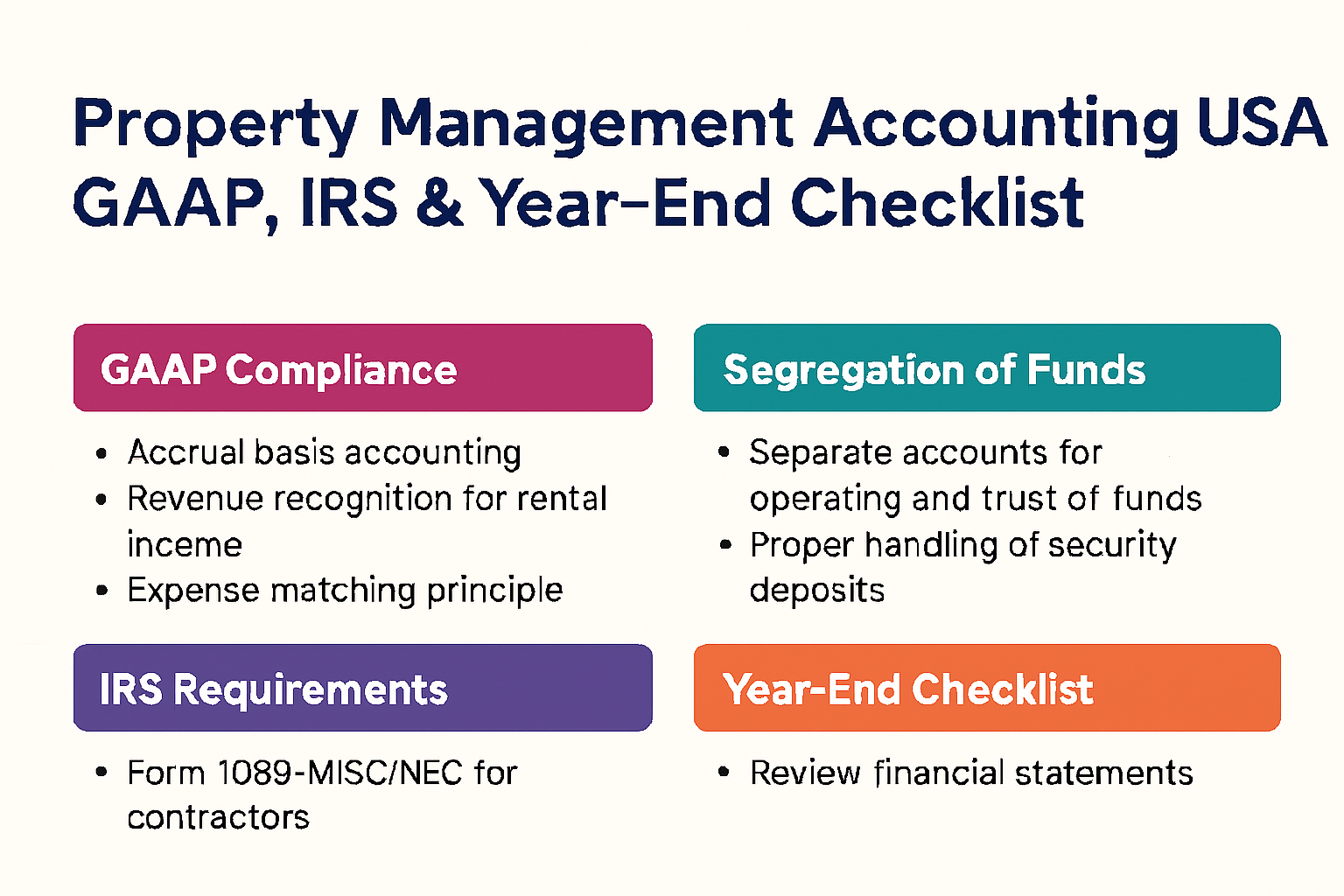
Property Management Accounting USA: US GAAP, IRS-Compliant Practical Guide and Year End Checklist
Real estate Property management accounting in USA is not ordinary bookkeeping. It involves fiduciary responsibility, strict fund segregation, property-level profitability tracking, tenant accountability, and compliance with both US GAAP and IRS reporting requirements. Property managers collect rent on behalf of landlords, safeguard security deposits, allocate utilities, track mortgage and escrow balances and distribute net income to property owners. Without a structured accounting framework aligned with US GAAP and IRS compliance, financial statements quickly become unreliable and regulatory risks increase.
This comprehensive guide explains how real estate property management accounting in USA should be structured, the relevant US GAAP references, IRS compliance considerations, journal entries, trust guidelines, a real-world case study, and a detailed year-end checklist.
Understanding the Structure of Real Estate Property Management Accounting in USA
Real estate property management accounting in USA operates across three layers.
Tenant Level: Tracks rent receivable, late fees, and security deposits.
Property Level: Tracks rental income, operating expenses, utilities, mortgage payments, escrow balances, and net operating income.
Owner Level: Tracks rent payable to landlords and prepares owner statements.
Segregation of funds is essential. Most property management firms maintain:
Operating Account – Company’s own income and expenses.
Trust Account – Rent collected on behalf of landlords.
Security Deposit Trust Account – Separate liability holding (often state-mandated).
Commingling funds may violate state real estate commission regulations and fiduciary obligations.
US GAAP References Applicable to Real Estate Property Management Accounting in USA
Real estate property management accounting in USA must align with US GAAP principles where financial statements are prepared on accrual basis. Key standards include:
Revenue Recognition – Under ASC 606 (Revenue from Contracts with Customers), management fee income should be recognized when services are performed, not necessarily when cash is received. Rental income collected on behalf of landlords is not revenue of the management company; it is a liability (agent relationship principle). At the of receipt of rent, management fee income can be recorded with predefined % of share in rent and rest amount would be consider as liability towards the property owners.
Principal vs Agent Consideration – ASC 606 also requires evaluation of whether the property manager acts as a principal or agent. In most cases, property managers are agents, meaning gross rent collected is not company revenue. Only the management fee is revenue.
Security Deposits – Under US GAAP, security deposits are liabilities until refunded or applied. They cannot be recognized as income unless forfeited.
Mortgage Accounting – ASC 835 addresses interest recognition. Mortgage principal reduces liability; only interest is expensed.
Escrow Balances – Escrow amounts funded for property taxes or insurance are recorded as assets until applied to expense.
Accrual Accounting – Expenses should be recorded in the period incurred under the matching principle.
Using QuickBooks for Property-Level Tracking for Property Management Accounting
Many firms use QuickBooks Online for real estate property management accounting in USA. Proper configuration in Quick Books is very critical and its has to be done with due care as this help to generate desired report to analyse the profitability and financial position.
Recommended structure:
Location = Property Name
Class = Activity Type (Management, Maintenance, Leasing)
Customer = Tenant
Vendor = Landlord
This allows Profit & Loss by Property and accurate owner statements.
Core Accounting Entries in Real Estate Property Management Accounting in USA
Recording Rent Collected (Agent Model under US GAAP)
Dr. Trust Bank Account
Cr. Rent Payable to Landlord
Recording Management Fee (Revenue under ASC 606)
Dr. Rent Payable to Landlord
Cr. Management Fee Income
Transferring Management Fee to Operating Account
Dr. Operating Bank Account
Cr. Trust Bank Account
Recording Security Deposit
Dr. Security Deposit Trust Bank
Cr. Security Deposit Liability
Recording Escrow Funding
Dr. Escrow Asset
Cr. Trust Bank Account
Applying Escrow
Dr. Property Tax or Insurance Expense
Cr. Escrow Asset
IRS Compliance in Real Estate Property Management Accounting in USA
Beyond US GAAP, real estate property management accounting in USA must comply with IRS regulations.
Form 1099-NEC – Vendors paid $600 or more for services during the year must receive Form 1099-NEC. Property managers must track vendor payments carefully.
Form 1099-MISC – In some cases, landlords receiving rental income through property managers may require reporting depending on structure.
Backup Withholding – If vendor EIN is missing, backup withholding rules may apply.
Rental Income Reporting – Owners report rental income on Schedule E (Form 1040) or through entity returns (Partnership Form 1065, S Corp Form 1120-S, etc.). Accurate owner statements are critical for tax reporting.
Depreciation Tracking – Although depreciation is usually handled at owner level, property managers should maintain asset records to assist CPAs.
Trust Accounts – Trust funds are not taxable income to the property manager. Only management fees are taxable revenue.
Monitoring AR Aging and Rent Roll by Property Managers
In property management accounting, monitoring Accounts Receivable (AR) aging and maintaining an accurate rent roll are two of the most critical internal control functions. These reports are not just operational tools to track and control— they directly impact cash flow, landlord reporting accuracy, and overall property profitability.
Accounts Receivable Aging Report
An AR Aging Report categorizes outstanding tenant balances based on how long the amount has been overdue. Typically, balances are grouped into:
• Current (not yet due)
• 0–30 days overdue
• 31–60 days overdue
• 61–90 days overdue
• 90+ days overdue
This report helps property managers quickly identify delinquent tenants and prioritize collection efforts.
From an accounting perspective, AR aging also helps in:
• Evaluating doubtful accounts under accrual accounting.
• Assessing whether late fees should be imposed.
• Identifying chronic defaulters across properties.
• Estimating bad debt provisions (if applicable under US GAAP).
Regular weekly review of AR aging ensures that rent leakage is controlled and cash flow remains stable.
Rent Roll Report
The Rent Roll is the master property-level occupancy and income tracking document. It provides a snapshot of every unit within a property and must reconcile with the Accounts Receivable ledger at month-end.
A comprehensive rent roll should include:
• Property name
• Unit number
• Tenant name
• Lease start date
• Lease end date
• Monthly rent amount
• Security deposit held
• Additional recurring charges (parking, CAM, utilities)
• Lease status (active, month-to-month, vacant, notice given)
The rent roll serves multiple purposes:
- Confirms total scheduled monthly rental income.
- Identifies vacancies and occupancy rate.
- Verifies security deposit liability balances.
- Supports lender and investor reporting.
- Validates revenue recognized under accrual accounting.
Reconciliation Between AR Aging and Rent Roll
At the end of each month, the total tenant receivable balance per AR Aging must match the outstanding balances reflected in the Rent Roll. Any mismatch may indicate:
• Misapplied tenant payments
• Unrecorded journal entries
• Incorrect opening balances
• Security deposit adjustments posted incorrectly
• Data entry errors
This reconciliation is a key internal control step in property management accounting.
Late Fees and Interest Monitoring
If lease agreements allow, late fees and interest should be automatically applied after the grace period. The accounting entry typically is:
Dr. Tenant Accounts Receivable
Cr. Late Fee Income
These additional charges must also appear in AR Aging to ensure follow-up and collection.
Monitoring AR Aging alongside the Rent Roll gives management a complete view of:
• Scheduled rent vs. actual collections
• Collection efficiency ratio
• Vacancy percentage
• Property-level cash flow risk
Utilities Allocation and Property-Level Profitability
Utility expenses covering multiple properties must be allocated properly to measure true profitability.
Dr. Utilities Clearing
Cr Bank Account
Allocation Entry
Dr. Utilities Expense – Property A
Dr. Utilities Expense – Property B
Cr. Utilities Clearing
Proper allocation ensures accurate Net Operating Income (NOI).
Case Study on Property Management Accounting: Correcting an Accounting Disaster
A mid-sized property management company overseeing 12 residential properties approached us after facing repeated owner complaints and reconciliation issues. Upon review, we identified fundamental breakdowns in their accounting structure. All rent collected from tenants was being recorded as income in the company’s operating account, rather than as a liability payable to landlords. This directly violated the agent model under US GAAP, where property managers act as agents and should recognize only their management fee as revenue. Additionally, tenant reimbursements for utilities and repairs were booked as revenue, artificially inflating top-line income. Mortgage principal payments were incorrectly expensed instead of reducing loan liability, distorting net income.
Security deposits were another major concern. They were mixed with operating funds instead of being held in a separate trust account, resulting in an understated security deposit liability of $48,000. There was no property-level tracking, no class segregation, and no reliable rent roll reconciliation. As a result, revenue was overstated by 18 percent and owner statements were inaccurate.
We redesigned the chart of accounts, activated property and class tracking in QuickBooks Online, separated trust and operating accounts, reclassified rent as a landlord liability, corrected reimbursement treatment, reconciled security deposits tenant-wise, and rebuilt the rent roll from lease agreements. Within two months, the books were fully aligned with US GAAP and structured properly for IRS reporting and owner transparency. We have prepared comprehensive profit and loss account including property level profitability so that management can decide how much they are earning from any property and is there any need to increase rent at the time of renewal if any property is loss making.
Year-End Checklist for Real Estate Property Management Accounting in USA
Reconcile operating, trust, and security deposit accounts.
Perform three-way trust reconciliation.
Reconcile tenant security deposit liabilities.
Review AR aging and evaluate doubtful accounts.
Confirm rent roll accuracy.
Match mortgage balances to lender statements.
Reconcile escrow balances.
Accrue unpaid expenses under US GAAP accrual rules.
Review management fee revenue recognition timing.
Prepare 1099-NEC vendor reporting.
Review owner distributions and payable balances.
Defer the future period rent recrived in advance
Close income and expense accounts.
Backup accounting data securely.
Document compliance review for audit trail.
Conclusion
Real estate property management accounting in USA requires structured systems aligned with US GAAP and IRS compliance. Property managers act as agents, not principals, meaning rental income collected belongs to landlords and must be recorded as liability only property management fee can be recorded as income. Security deposits are liabilities. Mortgage principal reduces debt, not expense. Escrow balances must be tracked accurately.
With proper configuration of accounting systems, disciplined trust reconciliation, structured reporting, and professional outsourcing support, property managers can maintain compliance, transparency, and property-level profitability. Real estate property management accounting in USA is not just bookkeeping — it is fiduciary stewardship backed by accounting precision and regulatory discipline. QuickBooks online can the one of the best tool to manage property management accounting and comprehensive reporting.