
How to Choose the Right Outsourced Accounting Partner for Your Business
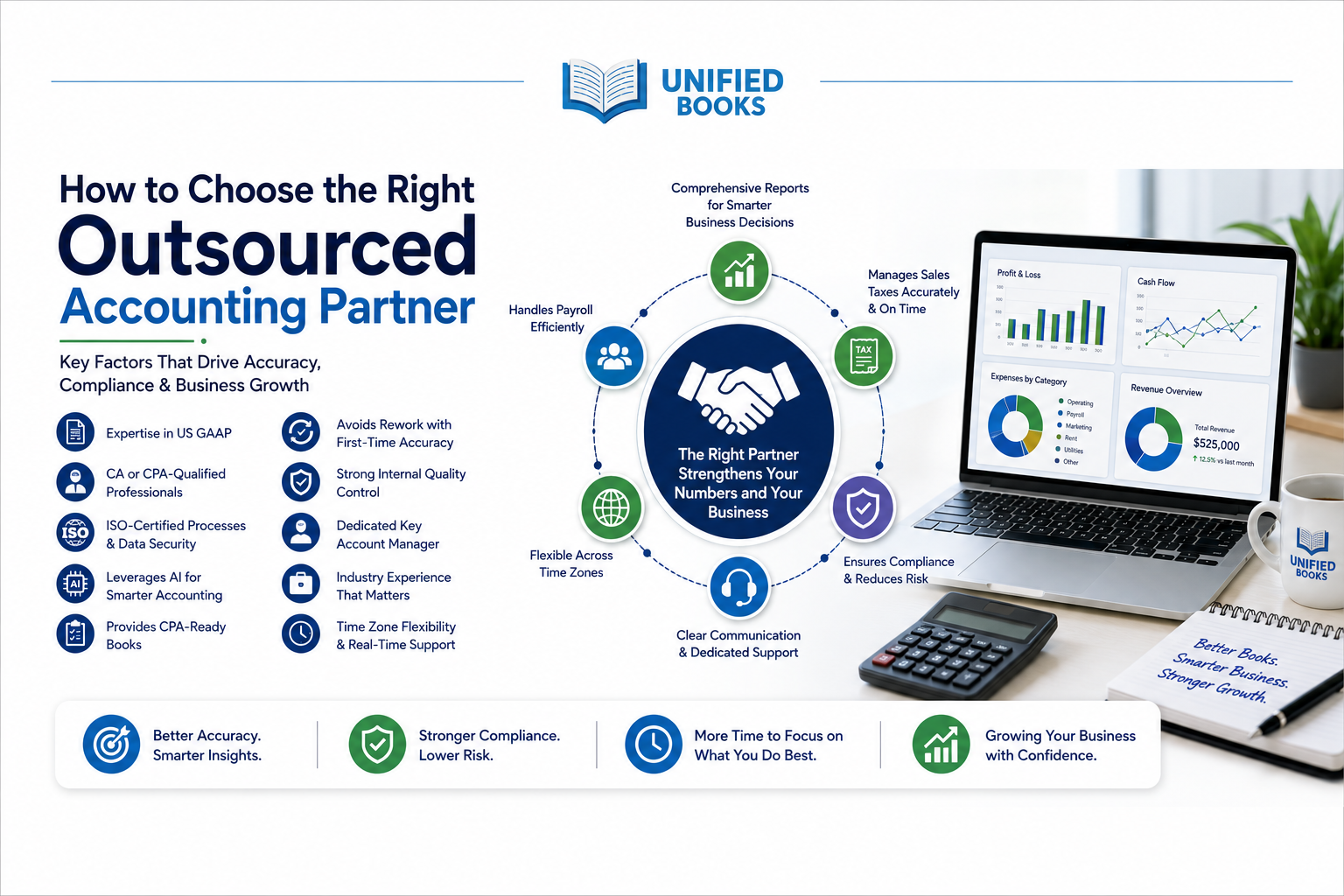
How to Choose the Right Outsourced Accounting Partner for Your Business
Outsourcing your accounting is no longer just a cost-cutting move—it’s a strategic decision that directly impacts your financial clarity, compliance, and growth. But here’s the reality: not every outsourced accounting partner delivers the same level of quality.
If you're searching for how to choose the right outsourced accounting partner, you're already thinking in the right direction. The goal isn’t just to outsource—it’s to build a reliable financial backbone for your business.
Let’s break down exactly what to look for.
1. Ensure Strong Expertise in US GAAP
This is non-negotiable.
Your outsourced accounting partner must have hands-on experience with US GAAP standards. Many firms claim expertise, but the difference lies in practical exposure—handling real US clients, audits, and CPA reviews.
A firm well-versed in US GAAP ensures:
- Accurate revenue recognition and expense classification
- Compliance with IRS and state-level requirements
- Seamless coordination with your CPA
- Reduced audit risks
If your goal is clean, reliable books, this is your starting point. Learn how to recognise revenue as per US GAAP
2. Prefer CA or CPA-Qualified Professionals
Behind every accurate report is a qualified professional.
When your outsourced accounting firm has CA or CPA-qualified managers, it reflects:
- Strong technical foundation
- Ability to handle complex adjustments
- Better understanding of compliance and reporting standards
This becomes even more important when scaling your business or dealing with multi-entity structures.
3. Check for ISO Certification
ISO certification is often overlooked—but it’s a strong indicator of process maturity.
An ISO-certified outsourced accounting firm typically follows:
- Documented workflows
- Data protection protocols
- Standardized quality checks
This is especially important when you’re sharing sensitive financial data through online bookkeeping systems.
4. Choose a Firm That Uses AI in Accounting
Modern accounting is evolving fast—and AI is at the center of it.
A forward-thinking outsourced accounting partner uses AI to enhance:
- Data extraction from invoices and bank feeds
- Auto-categorization in remote bookkeeping systems
- Error detection and anomaly tracking
- Faster month-end closing
AI doesn’t replace humans—it empowers them to deliver faster and more accurate results. Learn how AI in Accounting works
5. Look for CPA-Ready Books
Your ultimate goal should be simple: books that require zero cleanup.
CPA-ready books include:
- Proper reconciliations
- Supporting schedules
- Clean ledgers with correct classifications
- Complete audit trails
This reduces back-and-forth during tax season and ensures your online bookkeeping is always aligned with compliance requirements.
6. Avoid Firms That Cause Rework
Rework is a silent profit killer.
If your CPA or internal team has to repeatedly fix entries, it leads to:
- Delays in reporting
- Increased accounting costs
- Frustration across teams
The right outsourced accounting firm focuses on first-time accuracy, especially in remote bookkeeping environments where coordination matters more.
7. Strong Internal Quality Control is a Must
Quality doesn’t happen by accident—it’s built through systems.
Ask your outsourced accounting partner about:
- Multi-level review structure (preparer → reviewer → manager)
- Standard checklists for every delivery
- Error logs and continuous improvement systems
Firms with strong internal controls ensure consistency across all online bookkeeping processes.
8. Dedicated Key Account Manager
One of the biggest frustrations in outsourcing is communication gaps.
A dedicated account manager ensures:
- Clear and consistent communication
- Faster turnaround on queries
- Deep understanding of your business model
This becomes even more valuable when managing ongoing remote bookkeeping operations.
9. Industry-Specific Experience Matters
Every industry has its own accounting nuances.
For example:
- Real estate: lease accounting, CAM reconciliation
- eCommerce: multi-channel sales, payment gateways
- Healthcare: insurance adjustments
An outsourced accounting firm with industry experience can:
- Reduce onboarding time
- Improve accuracy
- Deliver better financial insights
10. Time Zone Flexibility
Time zone mismatch can slow everything down.
The right outsourced accounting partner should:
- Offer overlapping working hours
- Be available during your business-critical times
- Provide quick turnaround on urgent requests
This is crucial for smooth collaboration in remote bookkeeping setups.
11. Comprehensive Financial Reports for Decision Making
Good accounting doesn’t just record history—it guides the future.
Your outsourced accounting partner should provide:
- Monthly P&L and balance sheet
- Cash flow analysis
- Budget vs actual reports
- Custom dashboards based on KPIs
These insights turn your online bookkeeping system into a decision-making engine.
12. Ability to Handle Payroll and Sales Taxes
This is where many businesses struggle with multiple vendors.
A full-service outsourced accounting partner should also manage:
- Payroll processing (wages, deductions, filings)
- Multi-state sales tax compliance
- Timely filings and documentation
This creates:
- Better integration across functions
- Reduced compliance risks
- Simplified operations
13. Strong Expertise in Accounting Software (QuickBooks, Zoho, Xero, etc.)
Technology is the backbone of modern accounting.
Your outsourced accounting partner should have deep, hands-on experience in leading platforms like QuickBooks, Zoho Books, Xero, and other cloud-based tools. It’s not just about knowing the software—it’s about using it efficiently.
A firm with strong software expertise can:
- Set up and optimize your chart of accounts correctly
- Automate workflows within online bookkeeping systems
- Integrate apps (payments, payroll, inventory, etc.) seamlessly
- Reduce manual intervention through smart automation
- Ensure accurate reporting across platforms
This becomes even more critical in remote bookkeeping environments, where everything depends on how well technology is used.
Choosing a partner who truly understands these tools ensures:
- Faster turnaround time
- Better data accuracy
- Scalable systems as your business grows
In short, the right outsourced accounting firm doesn’t just “use” software—they leverage it to improve your entire financial ecosystem.
When your remote bookkeeping, payroll, and tax compliance are handled together, efficiency improves significantly. Check which accounting software is right fit for your business.
Final Thoughts: Choose Smart, Not Just Cheap
If you're serious about learning how to choose the right outsourced accounting partner, focus on value—not just cost.
The right partner will:
- Act as an extension of your team
- Deliver consistent accuracy
- Available as per business needs
- Use AI and Automation
- Deliver reports rather data
- Help you scale without operational stress
In today’s digital world, combining outsourced accounting, remote bookkeeping, and online bookkeeping with the right partner can transform your financial operations completely.
FAQs on Choosing Outsourced Accounting Services
1. What is outsourced accounting?
It is the process of hiring an external firm to manage bookkeeping, reporting, payroll, and compliance functions.
2. How to choose the right outsourced accounting partner?
Look for US GAAP expertise, qualified professionals, AI usage, strong quality control, and industry experience.
3. What is remote bookkeeping?
Remote bookkeeping allows businesses to manage financial records virtually using cloud-based tools.
4. What is online bookkeeping?
Online bookkeeping refers to maintaining books on digital platforms with real-time access and automation features.
5. Can outsourced firms handle payroll and sales taxes?
Yes, many full-service firms offer integrated payroll and tax compliance services.
6. Why are CPA-ready books important?
They reduce rework, save time during tax filing, and ensure compliance.
7. Is outsourcing accounting safe?
Yes, especially when working with ISO-certified firms with strong data security systems.
Written by